
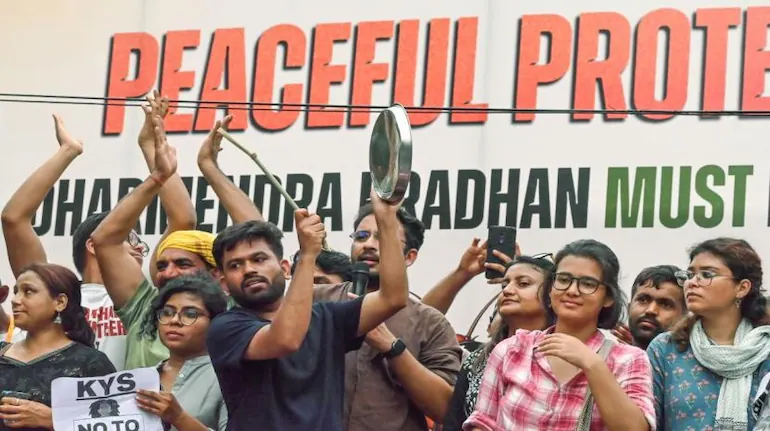
It’s season #2 of monsoon protests in India, something that has become more frequent and commonplace than our parliament’s sessions. This time our nation’s citizens are protesting the invalid deletion of millions of valid voters through a recent process introduced by the present government called SIR (Special Intensive Revision), mea inclusa. This process is strategically designed to weaken the democratic process, and boost the vote bank of the present government which ensures its perpetuity through the next few elections. Along with a few other recent acts like the CAA, this policy seeks to eradicate minority voters and usher in a uniformity in political and religious agendas as a nation. These are legitimate causes that are worth protesting in our land.
The Issue with Frontline Protests
However, not all of us are called to be frontline protestors. I, for one, have a fairly domestic calling that has recently been hijacked by the Instamafia. An unexpected like on a national newspaper clipping opened a floodgate of Gen Z posts on the protests in Freedom park, Jantar Mantar, and there was no running away from the guilt-tripping that ensued. “You’re either with us or with the fascist government”, “It’s now or never to come join this Neo-freedom-struggle”, “If you are sitting at home and warming your couch, your are an anti-national” (I never thought leftists slogans would sound so ridiculous but they really push those buttons). What was noteworthy was almost all these posts were liked or reshared by my Christian friends. Now I’m caught in the thicket. The noise was deafening in my quiet room. Should I repost? Would I be watched? Could I have been there? Should I be there as a Christian? Questions, questions. They all left me with with a queasy sense of uneasiness: If a Christian doesn’t wave the banner, is he complicit of evil? By banner, I meant cause. Over the last few months, and within circles of contemplation, I had begun to mull over the matter. There were several parameters to consider before one joined a cause. In my erstwhile days, every cause was triggered by a communist flag, or so I used to think. There was always a “red” flag in the cause, and the pun seems to hold true today before we wave one. Must a Christian wave a flag in every democratic protest that seems a just cause? Which flags must he wave, how and how much? When and where must he wave them? All of these merit thought. For instance, why must a Christian join the cause of SIR and call for resignations, while stay quiet on draconian anti-christian laws now being enacted in several states in India? Why are we praying for students in Jantar Mantar while not praying publicly and visibly outside abortion clinics where fateful mothers ring their babies’ death knell? Are we holding to double-standards? Or do we just choose causes only because the mob shows up at the door, or based on which mob shows up and how persistent their noise is? How are we to protest? By holding a Bonhoeffer poster? Sitting on an unending fast? Screaming slogans? Or be pressing into the government systems by legal chain of accountability? How many of us fast unto prayer? These and many other questions bothered me every time a protest erupted in India.
Don’t get me wrong. I’m not a pacifist, nor am I a government bootlicker. I’m a dissenter in every sense of that word, when it comes to God’s word. I have had to face off my parents, my only source of income and standing when I was 16. I was bullied in college for becoming a Christian (freak is the word), and quit all the clubs I was in, in public demonstration of my allegiance to Christ. I lost friends. I have lost family. I know what it is like to be on the losing end of the bargain of much of life. I count these as incomparable to the treasure of being found in Christ. To this day, my husband and I have made counter-cultural moves, sometimes vis-a-vis even popular opinions within the church, and have lived along with the blessing these choices brought into our lives. Suffice to say, I’m not a stranger to protests. But often I found myself going against the grain, not with it. It was me against the mob. Sarmishta contra mundum. A Christian will often look and be alone in a protest. That is the definition of Christian dissent. We don’t wait for consensus to count the cost of fight the cause. We do it when we are faced with it. And often, the Christian has to do it every. single. day.
A Christian will often look and be alone in a protest. That is the definition of Christian dissent.
The Alternative for a Christian
This brings me to a kind of protesting I fear Christians of this generation have barely been exposed to. A kind of protesting that is unGandhian and more Puritanical in its approach (ironically though Gandhi was called a puritan by Edgar Snow and C.F. Andrews). I’m going to call it the faithful-presence-protest. It simply means protesting through ordinary faitfulness in our everyday callings and vocations. It’s a Christian shining his inner light in a dark world and refusing to cower under a bushel. Take for instance the common problem of bribing within government institutions in India. What would it look like to practice a faithful-presence-protest? A Christian would refuse to take the short cut to get needed services by paying a bribe and wait, however long it took, to get the service. One may “protest” : Ah! But that’s not protesting, that’s becoming a door mat for these officials who will abuse and refuse you service. You are simply perpetuating a goon culture of bullying. Sadly there are some Christian leaders who permit bribery for rightful services, under the guise of victimhood and living in a fallen world. My question to them is this: how then can we redeem a system when Christians are pawns in perpetuating the same evil system? When a Christian refuses to pay a bribe but perseveres to show up to push his papers, he is modeling the persistent widow in her relentless courage. The official will sooner or later give up. My family has done this several times and every single time, we were able to get a work done without having to pay a bribe. Once an atheist lawyer who helped us with a registration paper pleaded with me to give a “small gift” which we sternly refused. He later became curious about the Christ we worshiped.
Another area where Christians can and should protest through faithful presence is their worship of Christ. Often the Lord’s Day worship is stalled for reasons ranging from work, sports practices to entertainment. When a Christian calls the Sabbath holy and refuses to take up ordinary labours, he leaves a distinguishing mark in this decaying world. A friend of mine was a freshman in the investment banking sector, and on his first high-performance job (he had to work 16 work shifts) he clarified that he would be resting on the Sabbath and worshiping his Lord. The HR manager cracked up thinking he was joking, but our man didn’t bat an eyelid. He was granted an exception on the grounds that his Saturdays would be packed with client work. He was an exceptional worker and seeing his extraordinary work ethic, his manager later ensured that no work would pile up on his Sabbaths or Mondays following. He was granted more than an exception – he was granted favour. At the age of 30 he became one of the youngest MDs in a large investment banking firm. “They that honor me, them I honour”, says the Lord (1 Samuel 2:30). The Olypian Eric Liddle likewise refused to run for the prized 100 meter dash because of his Sabbath convictions, only to go on and win gold in the 300 meter sprint, a relay he didn’t aim orpractice for.
Faithful presence is a mustard seed. You may wonder how change happens without fighting, shouting slogans or marching parades. It happens, little by little. Think about it. If every Christian in India refused to pay a bribe what would happen? They would say, “Don’t bargain with Christians, they wont budge”, and others would sit up, take note and do the same thing. In a few generations, the practice of bribery would beomce obsolete. Think about it. If every Christian kept the Sabbath holy, what would happen? Large workforces would shut down working on that day because teams may be spread thin, and new work laws that mandated Sundays as mandatory holidays would be brought in. Productvity would improve and people would go home and build families and progress a society. Life would slow down, and we would have learnt how to truly rest without the perennial buzz of the business districts. I remember once driving through a little town called Sparta in Illinois on the Sabbath. All shutters were closed. There was literally a pin-drop silence. I cannot explain the profound effect that scene had on my senses, or the tranquility that descended in my soul when the world around had stopped spinning, just for one brief day. All was well that day.
Faithful presence is a mustard seed. You may wonder how change happens without fighting, shouting slogans or marching parades. It happens, little by little.
Jesus Christ’s Revolutionary Way
Our activism need not to provocative and loud. It can be faithful and ordinary and it will move even the hardest man, or not. Our Lord was a lot like that. We hear this description about him in Isaiah, “He does not lift up his voice or made it known in the streets”(Is 42:2). What does he do instead? “A bruised reed He will not break nor snuff out a smouldering wick.” (Is 42:3) Jesus cared deeply. He was the greatest revolutionary who ever lived. But he wasn’t a zealot. He wasn’t a mobster. He worked His father’s will, sawing wood and scraping filthy feet. And those very feet took the Gospel a thousand miles away. Faithful presence is about doing God’s will even in the hardest circumstance and doing it consistently. It’s not a rising and ebbing emotion, a taking to the streets, a face-off with the enemy. It is quiet, consistent, and often unseen by the world. The Scottish covenanters had to practice faithful-presence-protests when faced with the mandate by Charles II to worship only in state-approved kirks following the King’s liturgy. They would meet in underground churches or conventicles, often in the bitter cold, open fields and dark forests. They were brutally tortured and killed for dissenting the king’s orders. James Guthrie, one of the stalwarts of the Covenanters, exclaimed at the executioner’s scaffold ““I durst [dare] not redeem my life with the loss of my integrity. It is better to suffer than to sin.”. Another figurehead of the Reformation in Scotland, Archibald Johnston, prayed this at his execution, “Lord, I die in the faith that thou wilt not leave Scotland, but that thou wilt make the blood of thy witnesses to be the seed of thy church, and return again and be glorious in this land”. They believed that their faith bore fruit only after their deaths. And boy did it rain down on that land! The killing times ultimately scaffolded on the the Stuart monarchy and ushered in an era of peace and tranquilly for the Kirk which later became Presbyterian.
Jesus leads the way in this kind of activism. A kind of activism that is quiet, faithful, patient and persevering. Unwavering. Enrobing a towel, sinking hands into a basin, washing weak feet. Waiting on the Father to do the real work of change.